Splat Paintings
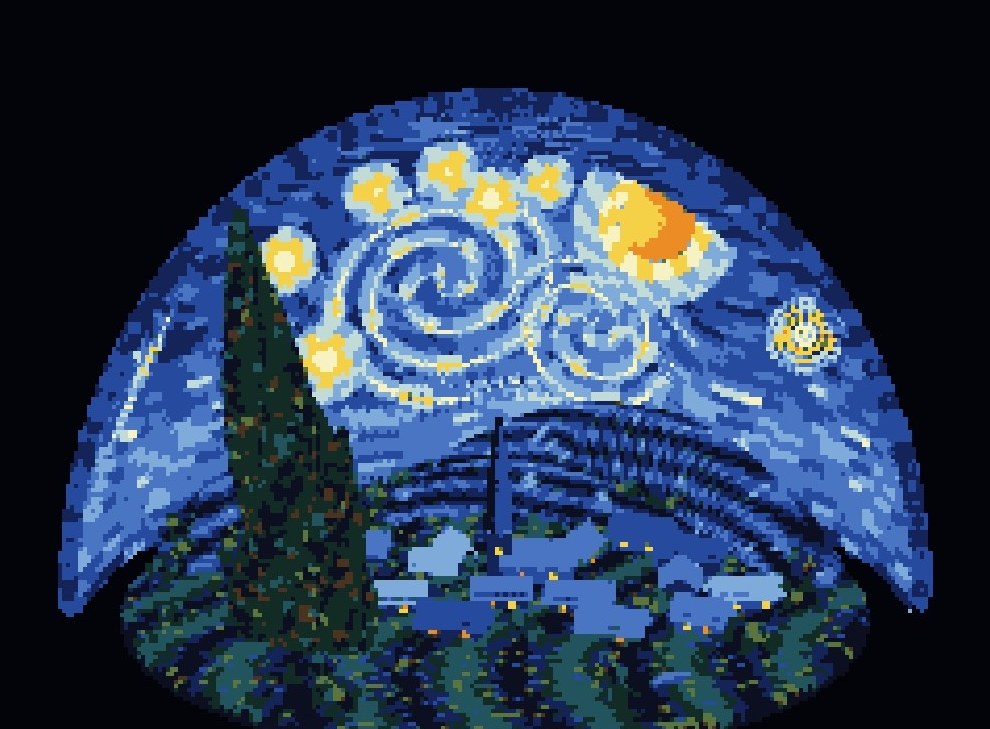
The first time I turned Hokusai's Great Wave into a Gaussian splat, it had 1,604,739 splats and worked from exactly one spot. Stand at the home camera and it was the print. Move, and it came apart into layers. The versions I kept go the other way: a few tens of thousands of splats each, sculpted from code, drawn at 216 pixels tall, and built to be looked at from the wrong side.
- 1,604,739
- Splats, first attempt
- 31,680
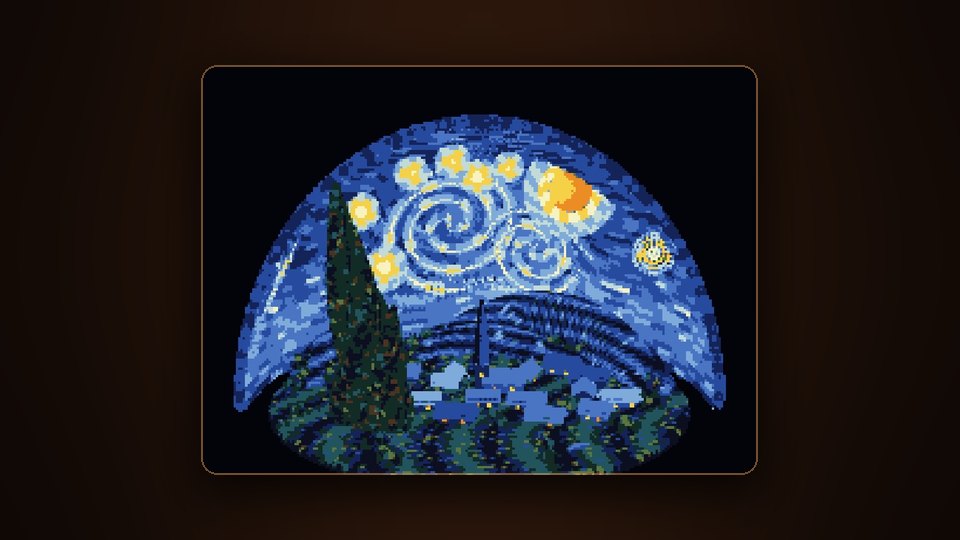
- Splats, The Starry Night
- 20,200
- Splats, Water Lilies
- 216 PX
- Render height
The idea
A painting is one camera angle that somebody committed to. I wanted to walk around three of them: Under the Wave off Kanagawa, The Starry Night and Water Lilies. None of the painters left notes about the back.
The first attempt
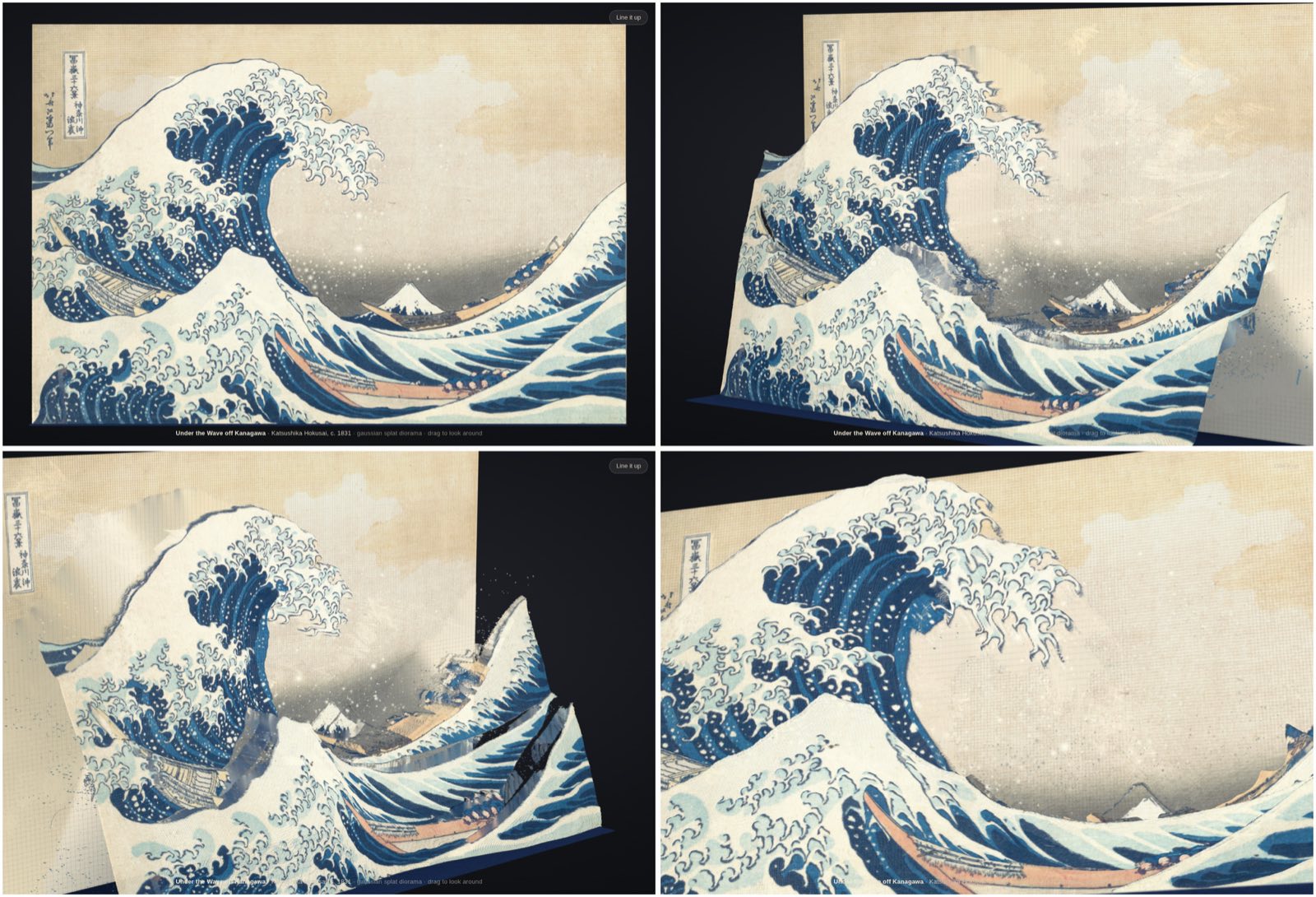
I estimated depth for the print, segmented the sky, Fuji and the boats with point prompts, and pushed every pixel toward the camera along its own ray. The print sits on a backdrop plane two units wide, with the home camera five units in front of it. From there everything lines up into the original. From anywhere else you get a 51 MB file demonstrating that a woodblock print is flat.
Sculpting it instead
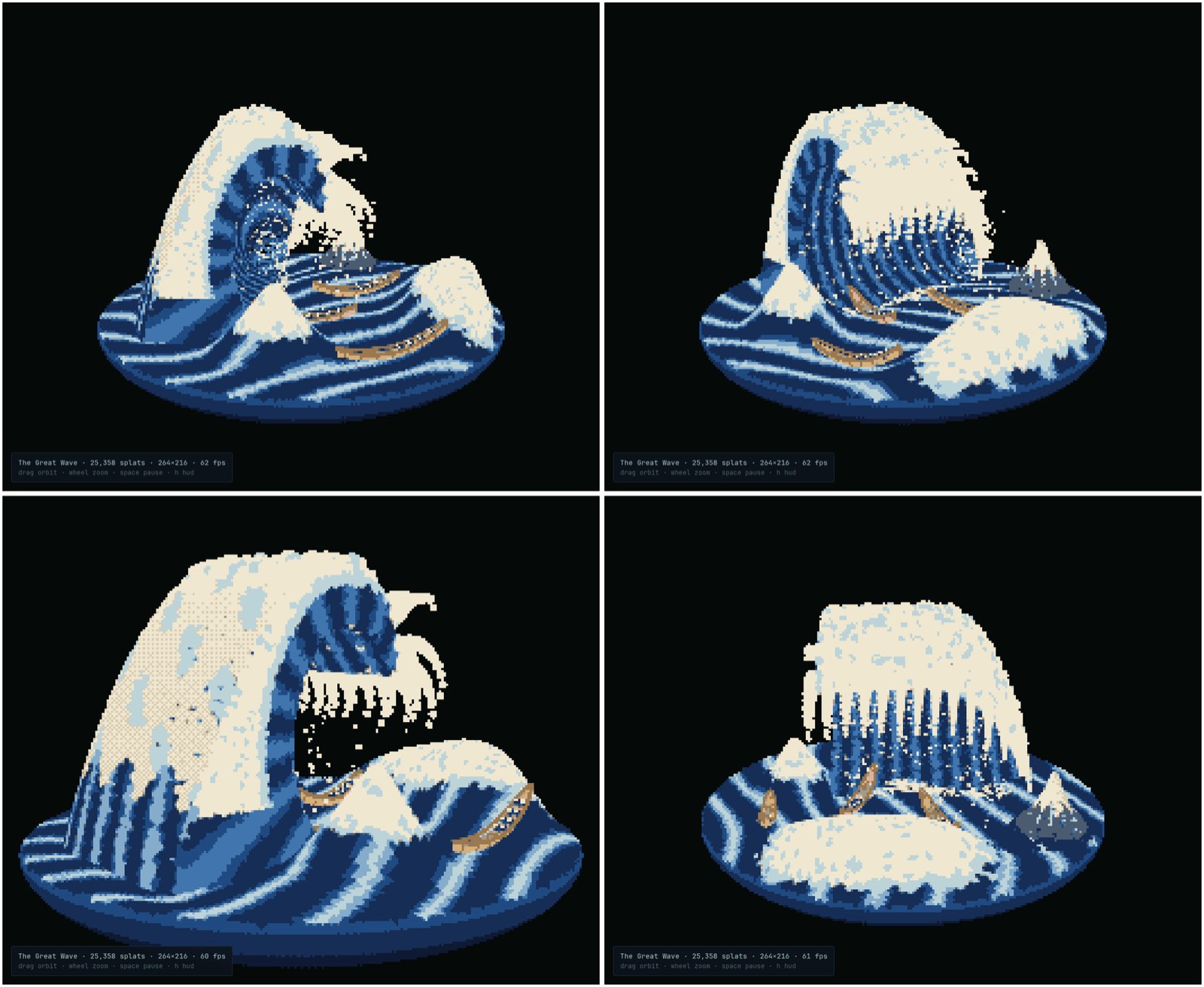
Each kept scene is one JavaScript file with a fixed palette, placing splats on simple shapes. The Great Wave is about 25,000 of them on a disc of sea. The wave's cross-section is two curves that meet at the lip, taken through five shapes on a nine-second cycle. The print's pose is the third. Then it finishes breaking, which the print has been declining to do since about 1831.
The Starry Night's sky is painted on the inside of a dome, and only the part facing away from the camera is drawn, so the far sky always sits behind the village. Water Lilies has no sky at all. What the painting shows as reflections is built as real depth under the surface, in a straight-sided tank, so clouds and willows slide under the lily pads as it turns. Both loop every eight seconds.
The viewer is one HTML file of WebGL2. It sorts the splats back to front with a counting sort and scales the result up with hard pixels.
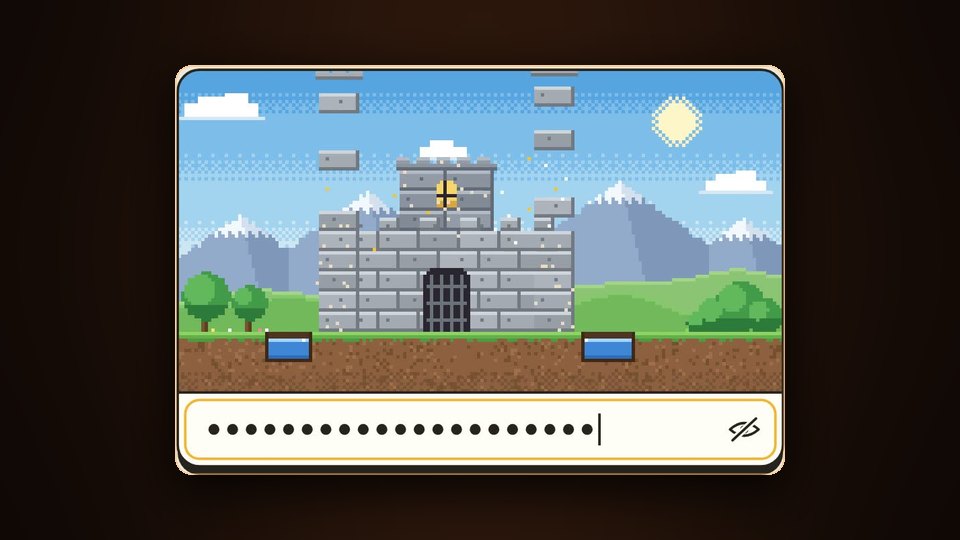
A fourth scene is mine, built on Monet's pond: a kneeling stone oni on an island, seven stone frogs facing him, a cherry tree leaning in from the bank. The frog is one generated 3D model placed seven times. Moss settles on whatever faces up. It runs 258,254 splats.
Where to see it
Nothing is hosted yet. What exists is the viewer on my machine, four turntable videos, and these stills.
Built with
- JavaScript
- WebGL2
- GLSL
- Gaussian splats
- Python
- NumPy
- OpenCV